Many business systems still run on .NET Framework 4.x: internal portals, ERPs, line-of-business web apps and Windows services built ten or more years ago. They still work, but they are harder to host, harder to hire for and cannot use the speed and security improvements of modern .NET. This guide explains what it costs to migrate a .NET Framework application to .NET 10 in 2026, how long it takes and how to keep the budget under control.
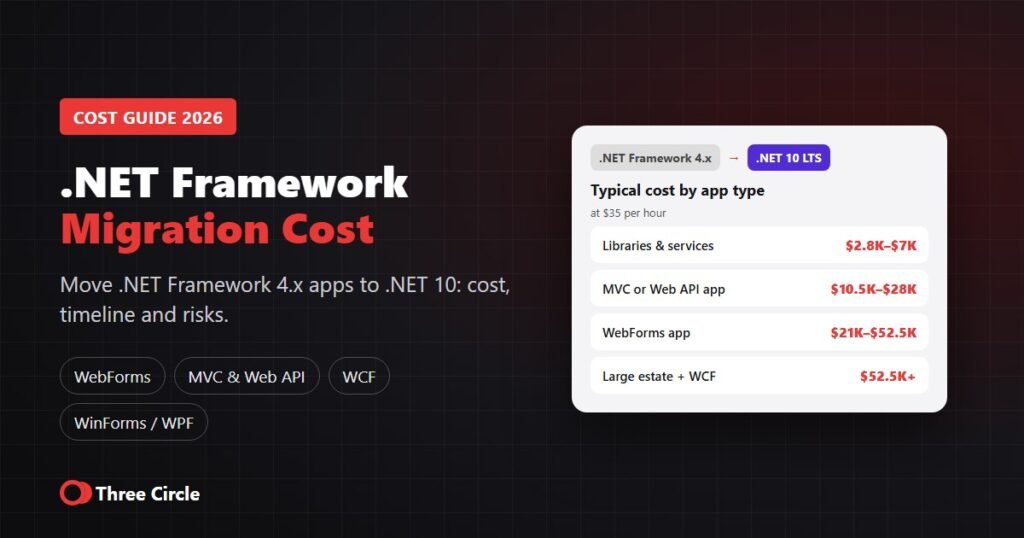
Short answer: at Three Circle’s rate of $35 per hour, migrating a .NET Framework application to .NET 10 typically costs about $2,800–$7,000 for class libraries, console apps and Windows services (80–200 hours), $10,500–$28,000 for an ASP.NET MVC or Web API application (300–800 hours), $21,000–$52,500 for an ASP.NET WebForms application whose user interface must be rebuilt (600–1,500 hours), and from about $52,500 for large estates with several apps and WCF services (1,500+ hours). Agencies charging US rates of $100–$200 per hour would typically quote three to six times more for the same hours.
.NET Framework migration cost by application type
| Application type | Typical work | Estimated hours | Estimated cost at $35/hr |
|---|---|---|---|
| Class libraries, console apps, Windows services | Retarget to .NET 10, update NuGet packages, replace a few unsupported APIs | 80–200 | $2,800–$7,000 |
| ASP.NET MVC or Web API | Move to ASP.NET Core: new startup, configuration, authentication, middleware and hosting | 300–800 | $10,500–$28,000 |
| ASP.NET WebForms | Rebuild the user interface in Blazor, Razor Pages or MVC and move business logic to .NET 10 | 600–1,500 | $21,000–$52,500 |
| WCF services | Move to CoreWCF, gRPC or REST APIs, then update every client that calls them | 200–600 | $7,000–$21,000 |
| WinForms or WPF desktop apps | Retarget to .NET 10 on Windows, update controls and third-party components | 150–500 | $5,250–$17,500 |
| Large estate (several apps, WCF, shared database) | Phased migration with incremental releases while the old system keeps running | 1,500+ | From about $52,500 |
These are typical ranges for planning. We confirm the scope and price in a written estimate after a free assessment of your code.
Why migrate from .NET Framework now?
- No new features: .NET Framework 4.8.1 is the final version. It still receives security fixes as part of Windows, but no new features or performance improvements.
- Long-term support: .NET 10 is the current long-term support (LTS) release, supported until November 2028.
- Hosting choice: modern .NET runs on Windows, Linux, containers, Azure and AWS, while .NET Framework web apps need Windows servers and IIS.
- Performance: ASP.NET Core is much faster than classic ASP.NET and needs fewer server resources.
- Hiring and libraries: new developers, NuGet packages and cloud SDKs focus on modern .NET.
What cannot move to .NET 10 as it is
- ASP.NET WebForms: not available in modern .NET, so the user interface has to be rebuilt. See our WebForms to ASP.NET Core migration guide.
- WCF server: not included in modern .NET. Options are the community CoreWCF project, gRPC or REST APIs.
- Windows Workflow Foundation: not included; use the community CoreWF project or rewrite the workflows.
- .NET Remoting and AppDomains: not supported; these parts need a new design.
- Entity Framework 6: can run on modern .NET, but most teams move to EF Core for long-term support and performance.
What drives the cost of a .NET Framework migration
- Technology used: WebForms and WCF add the most work; class libraries and Web APIs the least.
- Size of the codebase: number of projects, pages, services and integrations.
- Old dependencies: NuGet packages and third-party controls with no modern .NET version must be replaced.
- Automated tests: good test coverage makes the migration faster and safer; no tests means more manual checking.
- Hosting changes: moving from IIS on Windows to Linux, containers or Azure App Service.
- Extra changes: a new design or new features at the same time increase the scope.
How long does a .NET Framework migration take?
| Application | Typical timeline |
|---|---|
| Libraries, console apps, Windows services | 2–6 weeks |
| ASP.NET MVC or Web API application | 2–4 months |
| ASP.NET WebForms application | 3–6 months |
| Large estate with several apps and services | 6 months or more, released in phases |
The migration process, step by step
- Assessment: list every app, service and dependency, and scan the code with Microsoft’s .NET upgrade tooling to find unsupported APIs.
- Plan: choose a one-step migration for small apps, or an incremental migration for larger ones, where a proxy such as YARP sends finished pages to the new app while the rest still runs on the old one.
- Shared code first: move class libraries and business logic so both old and new apps can use them.
- Web layer and services: move controllers, APIs and services to ASP.NET Core, and rebuild WebForms pages.
- Test: run unit, integration, regression, performance and security tests.
- Hosting and CI/CD: update servers, containers, Azure or AWS settings and build pipelines.
- Release in stages: staging first, then production, with a rollback plan.
How to reduce the cost
- Migrate in stages so the business keeps running and each release is small.
- Move shared libraries first; they unlock the rest of the work.
- Keep the design the same during migration and improve it afterwards.
- Add automated tests for the most important workflows before you start.
- Remove features nobody uses instead of migrating them.
- Start with a paid or free assessment so the estimate is based on your real code.
.NET systems we have built
- Stallionex courier ERP: a complete courier ERP built on ASP.NET Core and SQL Server, with dispatch, warehouse, returns, tracking and courier integrations, live in production. Read the Stallionex case study.
- CannAvance: an enterprise healthcare and cannabis SaaS with microservices on React, Python, .NET and GraphQL. Read the CannAvance case study.
Get a .NET migration estimate
Three Circle is an ASP.NET development company registered in Texas and working with clients across the US. We migrate .NET Framework and WebForms systems to .NET 10 and support them afterwards. See our .NET migration services, hire dedicated .NET developers or read the ASP.NET development cost guide. Already on .NET 8? Read .NET 8 end of support: what to do now. Rates start from $35 per hour, projects from $1,000, and every migration starts with a written estimate. Request a free migration assessment.
Frequently asked questions
At $35 per hour, typically $2,800-$7,000 for libraries and services, $10,500-$28,000 for an ASP.NET MVC or Web API app, $21,000-$52,500 for a WebForms app and from about $52,500 for large estates with WCF services.
About 2-6 weeks for libraries and services, 2-4 months for an MVC or Web API app, 3-6 months for a WebForms app and 6 months or more for a large estate released in phases.
Not directly. WebForms is not available in modern .NET, so the business logic is moved to .NET 10 and the user interface is rebuilt in Blazor, Razor Pages or MVC, often page by page.
Yes. .NET Framework 4.8.1 still receives security fixes as part of Windows, but it gets no new features, so modern .NET is recommended for applications you keep developing.
Migrate to .NET 10. It is the current long-term support release, supported until November 2028, while .NET 8 support ends on November 10, 2026.
Yes. Larger applications are usually migrated incrementally: a proxy such as YARP sends finished parts to the new ASP.NET Core app while the rest keeps running on .NET Framework.