Smart devices need a good app: a fitness tracker, a medical sensor, a smart lock or an industrial IoT device is only as useful as the phone app that connects to it. This guide explains what a Bluetooth Low Energy (BLE) app costs to build in 2026, what each feature costs and what makes the price go up or down.
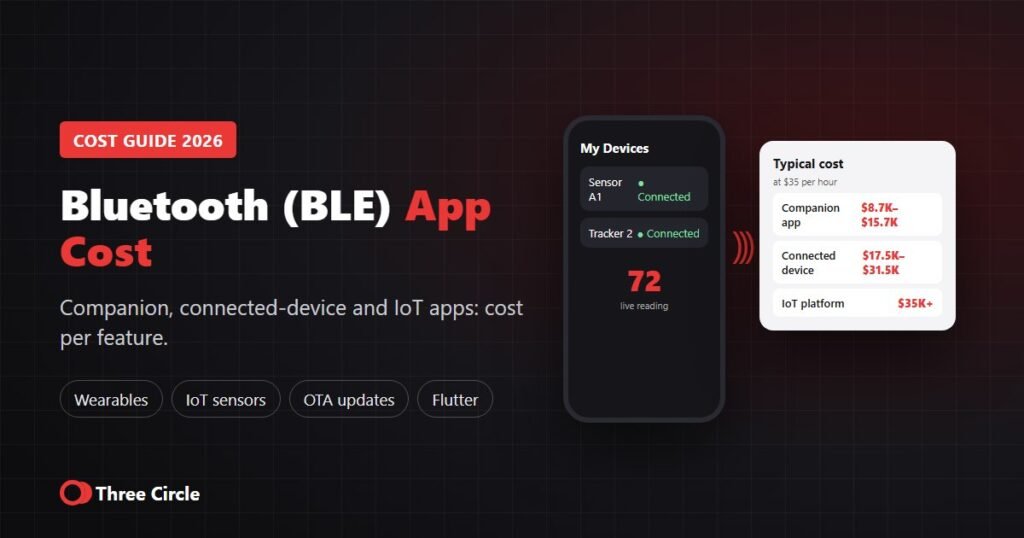
Short answer: at Three Circle’s rate of $35 per hour, a simple BLE companion app for one device typically costs about $8,750–$15,750 (250–450 hours), a connected-device app with user accounts, cloud sync and firmware updates about $17,500–$31,500 (500–900 hours), and an advanced IoT platform with many devices, dashboards and an admin portal from about $35,000 (1,000+ hours). Agencies charging US rates of $100–$200 per hour would typically quote three to six times more for the same work. Device firmware and hardware are priced separately.
Bluetooth app development cost by app type
| App type | Typical features | Estimated hours | Estimated cost at $35/hr |
|---|---|---|---|
| Simple BLE companion app | Scan and connect to one device type, read and control it, simple screens, iOS and Android (Flutter) | 250–450 | $8,750–$15,750 |
| Connected-device app | User accounts, several device types, history and charts, cloud sync, background reconnect, OTA firmware updates | 500–900 | $17,500–$31,500 |
| Advanced IoT platform | Fleets of devices, offline mode, beacons or proximity features, web dashboard, admin portal, roles, analytics | 1,000+ | From about $35,000 |
These are typical ranges for planning. We confirm scope and price in a written estimate after a free call about your device.
Cost per Bluetooth feature
| Feature | Estimated hours | Estimated cost at $35/hr |
|---|---|---|
| Device scanning, pairing and connection screens | 40–80 | $1,400–$2,800 |
| Reading, writing and live notifications (GATT services) | 40–100 | $1,400–$3,500 |
| Background connection and automatic reconnect | 40–80 | $1,400–$2,800 |
| Over-the-air (OTA) firmware updates from the app | 60–120 | $2,100–$4,200 |
| Charts, history and data export | 60–150 | $2,100–$5,250 |
| Cloud sync and back end (Azure or AWS) | 120–250 | $4,200–$8,750 |
| Beacons, proximity and indoor location | 60–120 | $2,100–$4,200 |
| Web dashboard or admin portal | 150–300 | $5,250–$10,500 |
What drives the cost of a Bluetooth app
- Your device’s BLE design: a well-documented device with clear GATT services is quicker to connect to than one with an undocumented or changing protocol.
- Number of device types and phone models: Bluetooth behaves differently across Android manufacturers, so testing on many real phones takes time.
- Background behaviour: keeping a connection alive or syncing data while the app is closed needs extra work on both iOS and Android.
- Data and cloud: storing readings, user accounts and dashboards add a back end on top of the app.
- Security and regulation: health and medical data need stronger encryption, audit trails and, for some products, regulatory documentation.
- Firmware updates: OTA updates need careful testing so a failed update never leaves a device unusable.
iOS, Android or Flutter for a Bluetooth app?
Native apps use Core Bluetooth on iOS and the Android BLE APIs. For most products we recommend Flutter with flutter_blue_plus: one codebase for iOS and Android, which usually cuts development cost compared with two native apps, while still giving full access to BLE features. Native code is still the right choice for rare cases that need very low-level control. See Flutter app development and Flutter vs native.
Things that surprise first-time device companies
- Phone permissions: Android 12 and later ask for separate Bluetooth scan and connect permissions, and iOS shows a Bluetooth permission prompt; the app must explain clearly why it needs them.
- No Apple MFi needed for BLE: Bluetooth Low Energy devices can work with iPhone apps without joining Apple’s MFi program, which is mainly for classic Bluetooth accessories.
- Real hardware is essential: emulators cannot test Bluetooth properly, so budget for development boards or device samples and a range of test phones.
- App store review: Apple and Google review how you use Bluetooth and background modes, so the app must have a clear user-facing reason for each.
Monthly costs after launch
- Cloud hosting for data sync and dashboards on Azure or AWS, growing with the number of devices.
- Apple Developer Program ($99 per year) and Google Play developer account (one-time $25).
- Maintenance for new iOS and Android versions and new phone models, often 15–20% of the build cost per year. See software maintenance cost.
How to reduce the cost
- Agree the BLE services and data format with your firmware team before app development starts.
- Build with Flutter for iOS and Android from one codebase.
- Launch with the core device features first; add dashboards and advanced features after real users try it.
- Start with a clickable design: we design 5–6 key screens free, with no obligation. See app design services and our MVP development offer.
Get a Bluetooth app estimate
Three Circle builds iOS, Android and Flutter apps that connect to wearables, IoT sensors, beacons and custom hardware, with cloud back ends on Azure or AWS. See our Bluetooth app development services, try the app development cost calculator or read how much it costs to build an app. Rates start from $35 per hour and projects from $1,000. Request a free estimate.
Frequently asked questions
At $35 per hour, typically $8,750-$15,750 for a simple BLE companion app, $17,500-$31,500 for a connected-device app with cloud sync and firmware updates, and from about $35,000 for an advanced IoT platform. Firmware and hardware are priced separately.
A simple companion app usually takes 2-3 months, a connected-device app 3-6 months and an advanced IoT platform 6 months or more, depending on the device and features.
Yes. Flutter with flutter_blue_plus supports scanning, connecting, reading, writing and notifications on iOS and Android from one codebase, which usually lowers cost compared with two native apps.
Usually not. Bluetooth Low Energy devices can work with iPhone apps without MFi; the MFi program is mainly for classic Bluetooth and some accessory types.
Yes. Over-the-air (OTA) firmware updates can be built into the app, typically 60-120 hours of work including testing.
No. These estimates cover the mobile app, cloud and dashboards. Firmware and hardware are separate, and we work alongside your firmware team to define the BLE services.